Which Volcanoes Count as Active? Test the 10,000-Year Rule on Smithsonian Data With JavaScript
Under the definition the Smithsonian Global Volcanism Program (GVP) applies, an active volcano is one that has erupted in roughly the last 10,000 years, the stretch since the last ice age ended. That rule is easy to state and harder to picture, so this tutorial pulls the GVP list of Holocene volcanoes and sorts it by last eruption in a short JavaScript script.
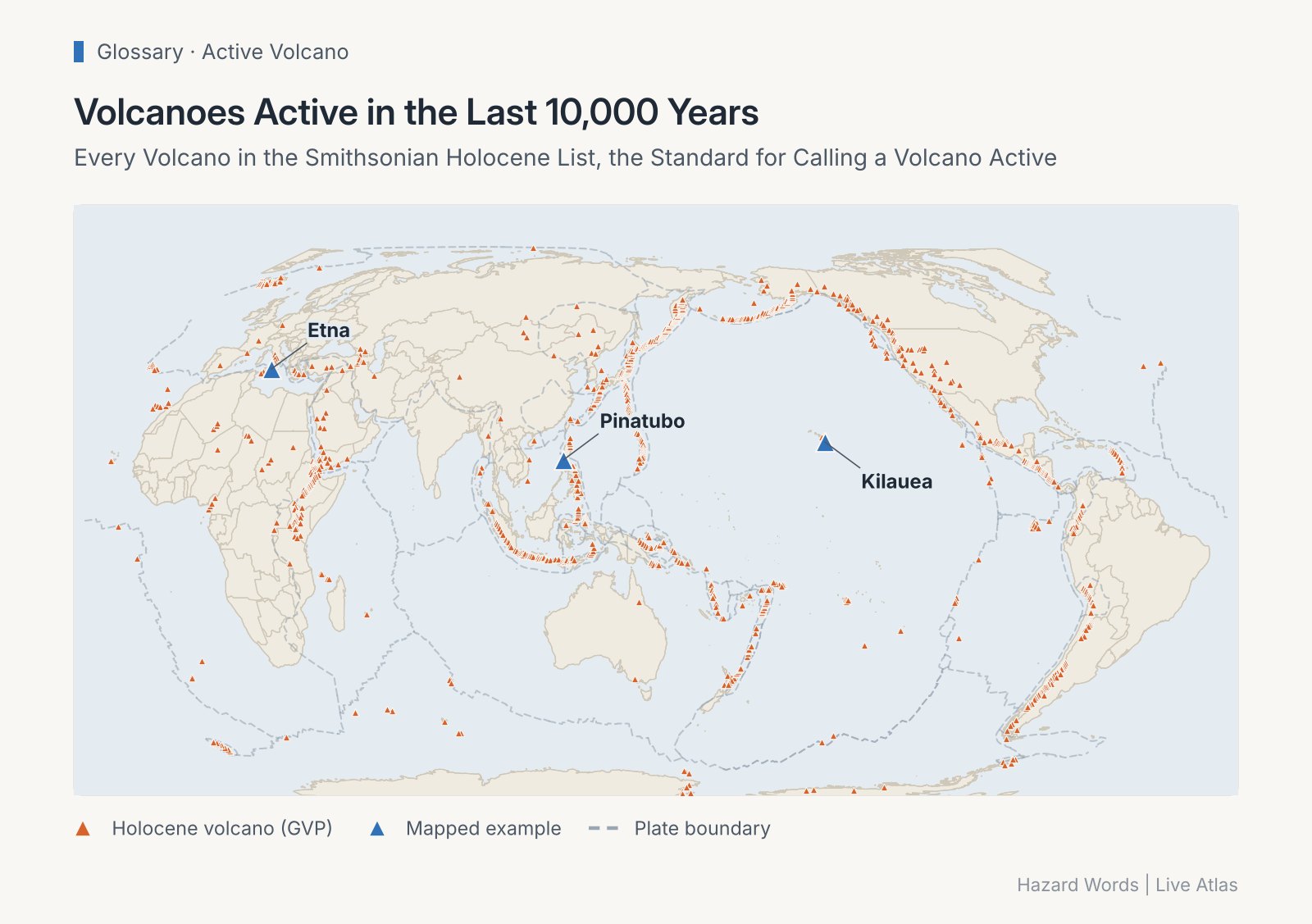
Volcanoes that erupted in the last 10,000 years cluster along plate boundaries.
The Query
The GVP GeoServer speaks WFS and answers in GeoJSON, with no key. Each feature carries the volcano name, the country, an Evidence_Category and a Last_Eruption_Year, where negative years are BCE and an empty value means no dated eruption.
const params = new URLSearchParams({
  service: "WFS",
  version: "2.0.0",
  request: "GetFeature",
  typeName: "GVP-VOTW:Smithsonian_VOTW_Holocene_Volcanoes",
  outputFormat: "application/json",
});

const res = await fetch(`https://webservices.volcano.si.edu/geoserver/GVP-VOTW/ows?${params}`);
if (!res.ok) throw new Error(`GVP service answered ${res.status}`);
const { features } = await res.json();

const volcanoes = features.map(({ properties: p }) => ({
  name: p.Volcano_Name,
  country: p.Country,
  evidence: p.Evidence_Category,
  lastEruption: p.Last_Eruption_Year, // negative years are BCE, null means no dated eruption
}));
console.log(`${volcanoes.length} Holocene volcanoes in the layer`);

const evidence = {};
for (const v of volcanoes) evidence[v.evidence] = (evidence[v.evidence] ?? 0) + 1;
console.table(evidence);

const thisYear = new Date().getFullYear();
const buckets = [
  ["since 2000", y => y !== null && y >= 2000],
  ["1500 to 1999", y => y >= 1500 && y < 2000],
  ["1 to 1499 CE", y => y >= 1 && y < 1500],
  ["BCE, still within the Holocene", y => y !== null && y < 1],
  ["no dated eruption", y => y === null],
];
for (const [label, test] of buckets) {
  console.log(label.padEnd(32), volcanoes.filter(v => test(v.lastEruption)).length);
}

const oldest = volcanoes.filter(v => v.lastEruption !== null).sort((a, b) => a.lastEruption - b.lastEruption)[0];
console.log(`Oldest dated last eruption: ${oldest.name} (${oldest.country}), ${-oldest.lastEruption} BCE, ${thisYear - oldest.lastEruption} years ago`);

const cutoff = thisYear - 10000; // 10,000 years ago, as a calendar year
const beyond = volcanoes.filter(v => v.lastEruption !== null && v.lastEruption < cutoff).length;
console.log(`Last eruption more than 10,000 years ago but still Holocene: ${beyond}`);

const us = volcanoes.filter(v => v.country.includes("United States")).length;
console.log(`United States entries: ${us}`);

for (const name of ["Pinatubo", "Etna", "Kilauea", "Chaine des Puys"]) {
  const v = volcanoes.find(x => x.name === name);
  console.log(name.padEnd(16), v ? `${v.lastEruption ?? "undated"} | ${v.evidence}` : "not found");
}
Save it as active.mjs and run node active.mjs (Node 18 or later). One request returns the whole layer, about 2.4 MB.
One trap is worth a note. In JavaScript null < 1 is true, because null turns into 0 in a comparison, so the undated volcanoes would land in the BCE group without the y !== null checks.
What It Prints
On November 20, 2026 the service returned 1,209 Holocene volcanoes. Grouped by last eruption, 234 erupted in 2000 or later, 345 between 1500 and 1999, 99 between the years 1 and 1499, and 171 only before the common era. The other 360 have no dated eruption at all.
The evidence field explains those 360. Eruptions were observed at 552 volcanoes and dated at 293. For 236 the evidence of Holocene activity is called credible, for 88 it is uncertain, and 40 qualify through unrest such as heat or gas.
The spot checks read as expected. Etna and Kīlauea list 2026, Pinatubo lists 2021, and the Chaîne des Puys in France, a field of cinder cones that looks long dead, last erupted around 4040 BCE and still counts. The United States accounts for 165 entries.
The Rule Is Really the Holocene
The 10,000 years are a round figure. The list follows the Holocene, the epoch that began about 11,700 years ago, and 10 volcanoes have a last eruption older than 10,000 years that still falls inside it. The oldest is Nantaisan in Japan, dated 9540 BCE, 11,566 years before 2026.
Why the Window Is So Long
Quiet spells mislead. Pinatubo in the Philippines had been quiet for about 500 years when it erupted in 1991, the event at the center of this profile of the Philippines between two trenches. A volcano called dormant has only been silent recently, and a silence of centuries can end.
The headline numbers differ with the source. The USGS answer on how many active volcanoes exist gives about 1,350 potentially active volcanoes worldwide, not counting the volcanic belts along seafloor spreading centers, and about 500 of them have erupted in historical time. The script shows why a figure near 1,200 or 1,350 depends on the year of the list and on how uncertain evidence is treated, and the glossary entry on active volcanoes maps Pinatubo, Etna and Kīlauea as examples.
For the same filter applied by country, see how the US ranking changes when only volcanoes active since 1960 are counted and the active volcanoes of Europe from Etna to Iceland. The caldera tutorial uses the same GVP service.
About the author
- Exploring the planet through interactive maps, open insights, and visual storytelling.
Comments
Join the discussionNo comments yet. Be the first to comment.