List the World's Calderas From the Smithsonian Volcano Database With JavaScript
A caldera is a wide volcanic basin left behind when the ground above an emptied magma reservoir loses its support and sinks. The USGS volcano glossary puts their width at about 2 to 50 km, many times the size of the vents inside them. The Smithsonian Global Volcanism Program (GVP) publishes its list of volcanoes as an open web service, so the calderas in it can be pulled out with a short script.
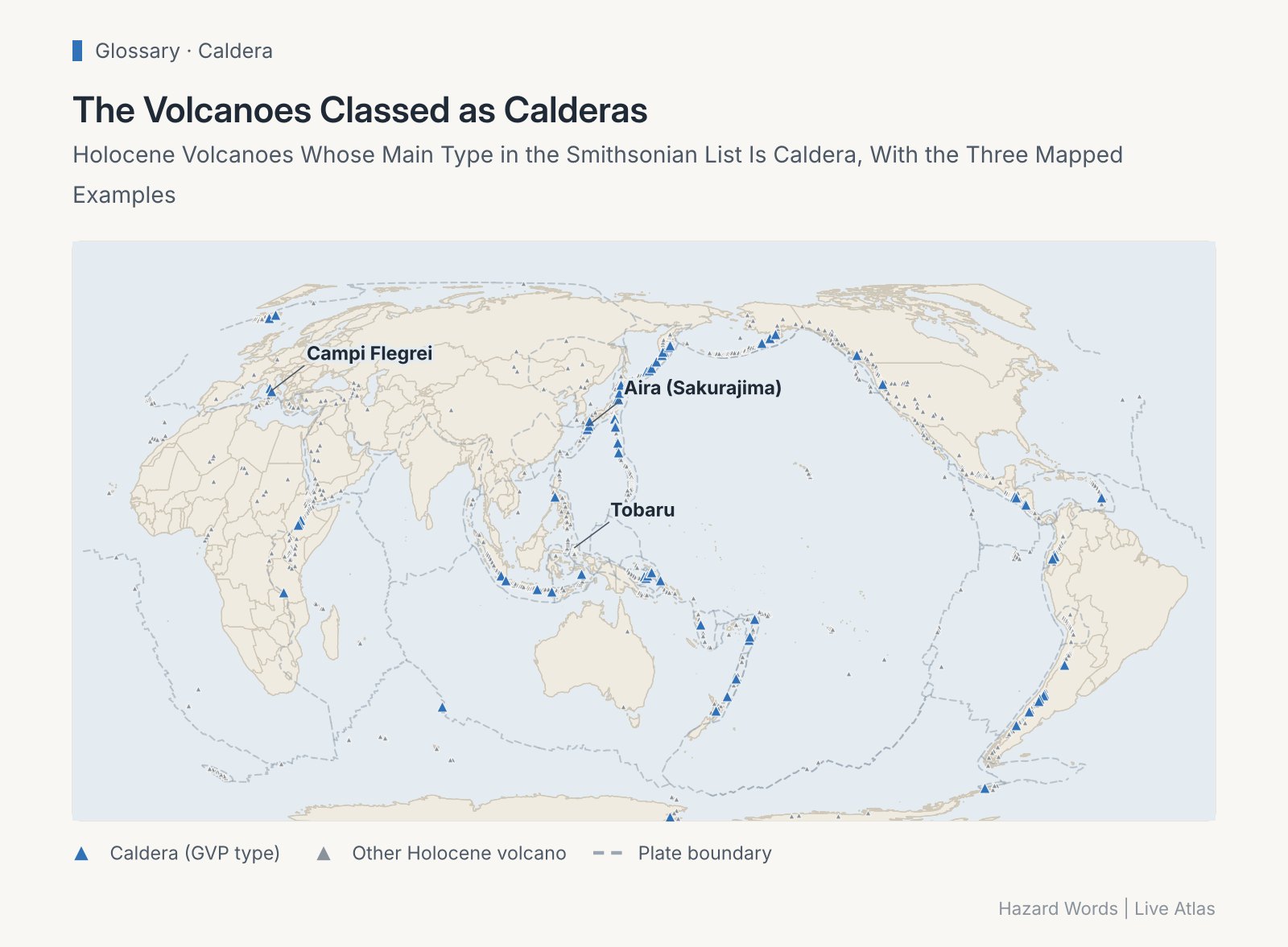
Calderas are scattered among the world's volcanoes, from Campi Flegrei near Naples to Aira in southern Japan.
The Query
The GVP GeoServer speaks WFS, a standard protocol for map features, and answers in GeoJSON when asked. It needs no key.
const params = new URLSearchParams({
  service: "WFS",
  version: "2.0.0",
  request: "GetFeature",
  typeName: "GVP-VOTW:Smithsonian_VOTW_Holocene_Volcanoes",
  outputFormat: "application/json",
});

const res = await fetch(`https://webservices.volcano.si.edu/geoserver/GVP-VOTW/ows?${params}`);
if (!res.ok) throw new Error(`GVP service answered ${res.status}`);
const { features } = await res.json();

const volcanoes = features.map(({ properties: p }) => ({
  name: p.Volcano_Name,
  country: p.Country,
  type: p.Primary_Volcano_Type ?? "",
  lastEruption: p.Last_Eruption_Year,
}));

const calderas = volcanoes.filter(v => v.type.startsWith("Caldera"));
console.log(`${calderas.length} of ${volcanoes.length} Holocene volcanoes are classed as calderas`);

const byCountry = {};
for (const c of calderas) byCountry[c.country] = (byCountry[c.country] ?? 0) + 1;
const top = Object.entries(byCountry).sort((a, b) => b[1] - a[1]).slice(0, 5);
console.log("Most calderas:", top.map(([c, n]) => `${c} ${n}`).join(", "));

const recent = calderas
  .filter(c => c.lastEruption >= 2000)
  .sort((a, b) => b.lastEruption - a.lastEruption);
console.log(`${recent.length} calderas list a last eruption in 2000 or later`);
Save it as calderas.mjs and run node calderas.mjs (Node 18 or later), or paste it into a browser console opened on webservices.volcano.si.edu.
What It Prints
On November 10, 2026 the service returned 1,214 Holocene volcanoes, and 85 of them have a primary type that starts with "Caldera". Japan leads with 17, ahead of Russia with 10, Indonesia with 9, Papua New Guinea with 6 and Ethiopia with 4. Twenty calderas list a last eruption year of 2000 or later, among them Taal in the Philippines and Aira in Japan, the caldera that holds Sakurajima.
Reading the Type Field
The filter uses startsWith because the database writes both "Caldera" and "Caldera(s)". Each volcano carries a single primary type, so the count covers only the volcanoes filed under caldera first. Campi Flegrei, beside Naples, comes back as a caldera whose last eruption year is 1538.
Why Calderas Collapse
The USGS glossary gives the mechanism. Magma leaves a shallow reservoir, either in a large eruption or by draining away underground, and the rock roof above has nothing left to hold it up, so it drops into the space. That is why a caldera is a basin rather than a peak.
Taal shows how active such a basin can be, as this note on the 2020 Taal eruption describes. For the opposite shape, a classic cone, compare it with Mount Fuji and its eruption record. A short caldera glossary entry maps Campi Flegrei and Sakurajima side by side.
About the author
- Exploring the planet through interactive maps, open insights, and visual storytelling.
Comments
Join the discussionNo comments yet. Be the first to comment.